The ORCA v1 is an open-source robotic hand designed to make human-like dexterity accessible to a much wider audience, from researchers and educators to hobbyists. Instead of being locked behind expensive, proprietary systems, ORCA provides full access to its design files, control code, and documentation, making it easy to build, modify, and experiment with.
ORCA: An Open-Source, Reliable, Cost-Effective, Anthropomorphic Robotic Hand for Dexterous Learning Video By: Soft Robotics Lab [SRL] / ETH Zurich
Technically, it features 17 degrees of freedom, a tendon-driven system, and integrated tactile sensing, allowing it to perform a wide range of manipulation tasks. But what really stands out is its practicality. The hand is built with reliability in mind, using “poppable” joints that safely dislocate under stress instead of breaking, along with auto-calibration, low-friction tendon routing, and a modular design for consistent performance.
It’s also affordable, with a material cost under 2,000 CHF. Most components are 3D printable, and the rest are easy to source, so you don’t need specialized equipment to get started. Assembly can be completed in under 8 hours using detailed guides.
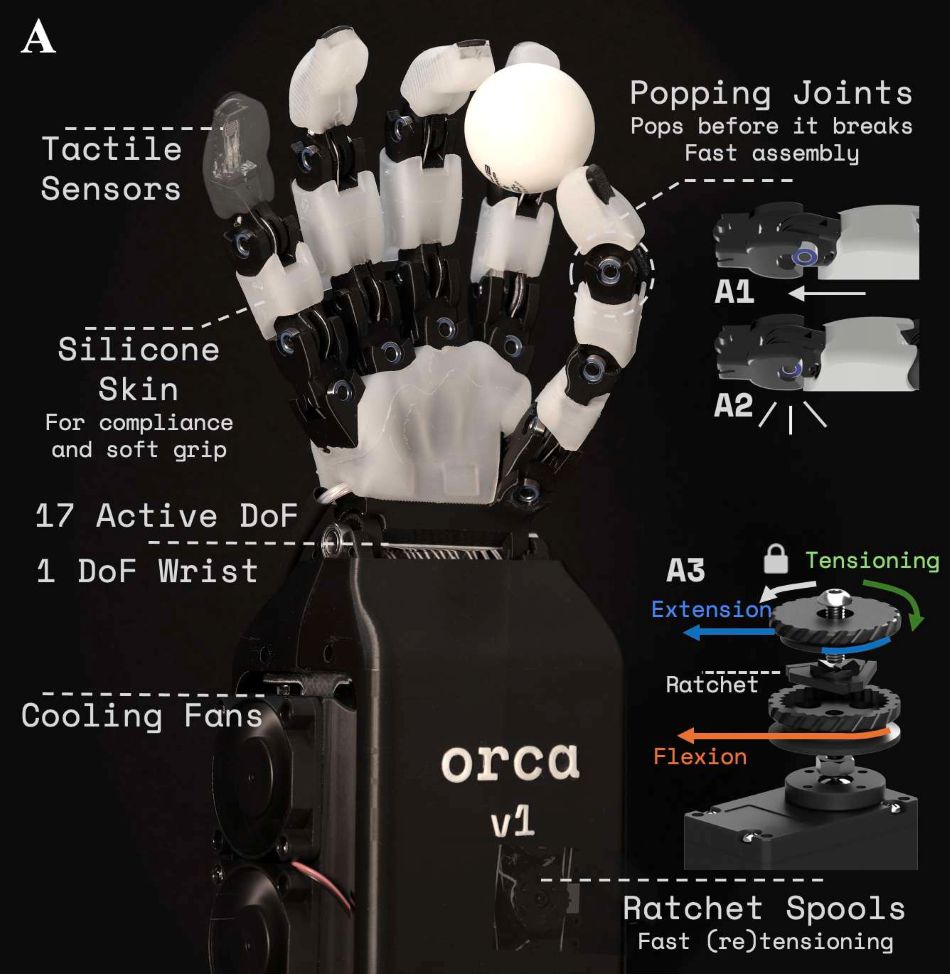
Because it closely follows the structure of a human hand, it’s easier to control and train using human data. Overall, ORCA stands out as a practical, fully open platform that lowers the barrier to entry for advanced robotic manipulation.
Source: ORCA Hand project
Official website and Reference: https://srl.ethz.ch/orcahand.html