
The Arduino Uno is the industry standard for rapid prototyping in embedded systems. At its core is the ATmega328P, an 8-bit RISC-based microcontroller that serves as the “brain” for reading sensors, processing data, and driving mechanical outputs like motors and displays.
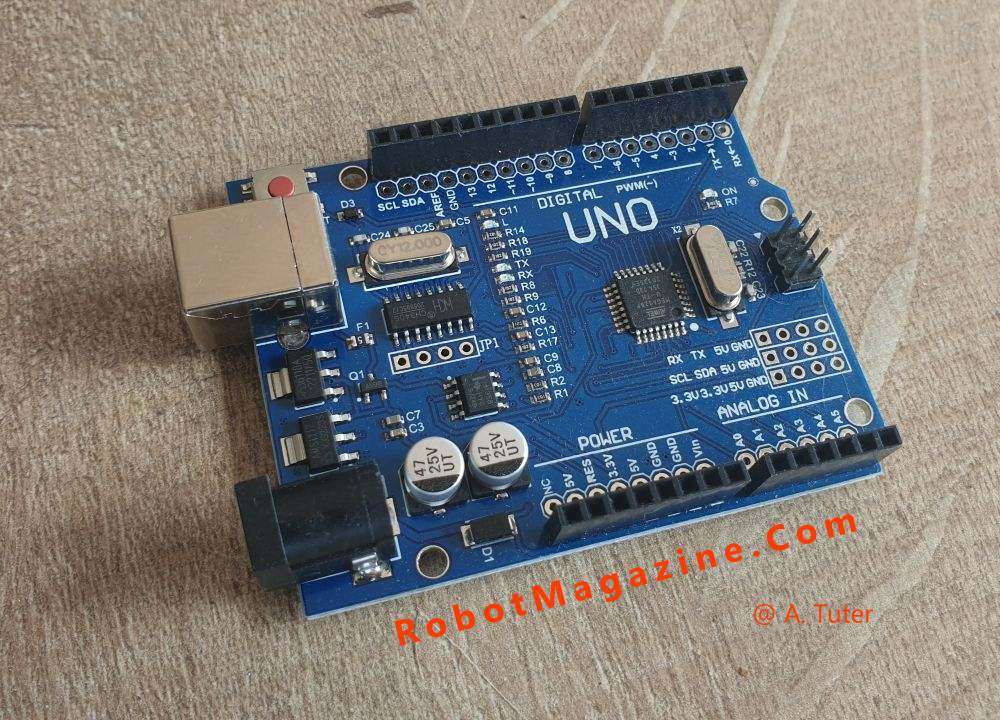
The Uno’s design is optimized for quick hardware interfacing, making it a reliable choice for initial engineering builds. It features 14 digital pins for communication, six of which support Pulse Width Modulation (PWM). This is essential for the precise control of servo motors and LED brightness. Additionally, six analog input pins allow the board to read varying voltage levels from sensors like temperature or ultrasonic distance modules.
Power versatility is another key feature. The board can be powered via a USB-B cable during development or through an external DC power jack (7V–12V) for untethered robotic operation. Onboard regulators provide stable 5V and 3.3V rails to protect any sensitive components you connect to the board.
Beyond the hardware, the Uno’s real strength lies in its accessibility. It uses a simplified C++ environment that reduces the complexity of programming. Thousands of pre-written libraries allow for near-instant integration of motor drivers and communication modules. While more powerful boards exist, the Uno’s 5V logic and physical durability make it easier to debug and more robust for controlling heavy-duty industrial components.
In both education and professional engineering, the Uno is a primary tool for moving from theory to a functional prototype. It is commonly used for robotic control, site monitoring in construction settings, and IoT prototyping. By lowering the barrier to entry, the Arduino Uno allows engineers to validate ideas on real hardware quickly before transitioning to more specialized, high-performance platforms.
Arduino Uno Technical Specifications
- Microcontroller: ATmega328P
- Operating Voltage: 5V
- Recommended Input Voltage: 7–12V
- Digital I/O Pins: 14 (6 of which provide PWM output)
- Analog Input Pins: 6
- Clock Speed: 16 MHz
- Flash Memory: 32 KB
- SRAM: 2 KB
- EEPROM: 1 KB
- USB Interface: USB-B
Terms of Use: Unauthorized copying is prohibited; we maintain dated records to document original publication. Content is provided “as is” and may contain inaccuracies; use it at your own risk. All trademarks mentioned belong to their respective owners; we are not affiliated with them, and no endorsement is implied. See our Terms Page.