
1. ROBOT MOTION PLANNING
Robot motion planning is the broad problem of determining how a robot should move from an initial state to a desired state while satisfying collision, kinematic, dynamic, and environmental constraints. Although the term covers a wide range of problems, two closely related but distinct forms are particularly important.
The first is path planning, also commonly associated with navigation planning. Here, the robot itself moves through its environment, for example traveling from one location to another while avoiding obstacles. The second is manipulator motion planning, in which the robot’s base remains stationary while its joints and links move to accomplish a task. An industrial robotic arm reaching around an obstacle to grasp an object is an example.
These two types of motion planning can also occur simultaneously. A mobile manipulator, for example, may move its base toward a workstation while its robotic arm changes configuration at the same time.
In the following sections, we assume primarily an industrial robotic arm operating in a structured environment. For humanoid robots, some aspects are different. A humanoid has many more degrees of freedom, complex whole-body motion, balance and contact constraints, and potentially changing support conditions. Nevertheless, the fundamental principles remain the same: representing the robot’s state, defining feasible and collision-free configurations, considering kinematic and dynamic constraints, generating paths or trajectories, and continuously adapting motion as conditions change.
1.1 PATH PLANNING
Path planning determines a collision-free route from a robot’s initial state to a desired goal state. For a mobile robot, this usually means finding a route through the environment while avoiding obstacles. The planner explores possible motions, rejects those that cause collisions, and selects a feasible route according to criteria such as distance, safety, or efficiency.
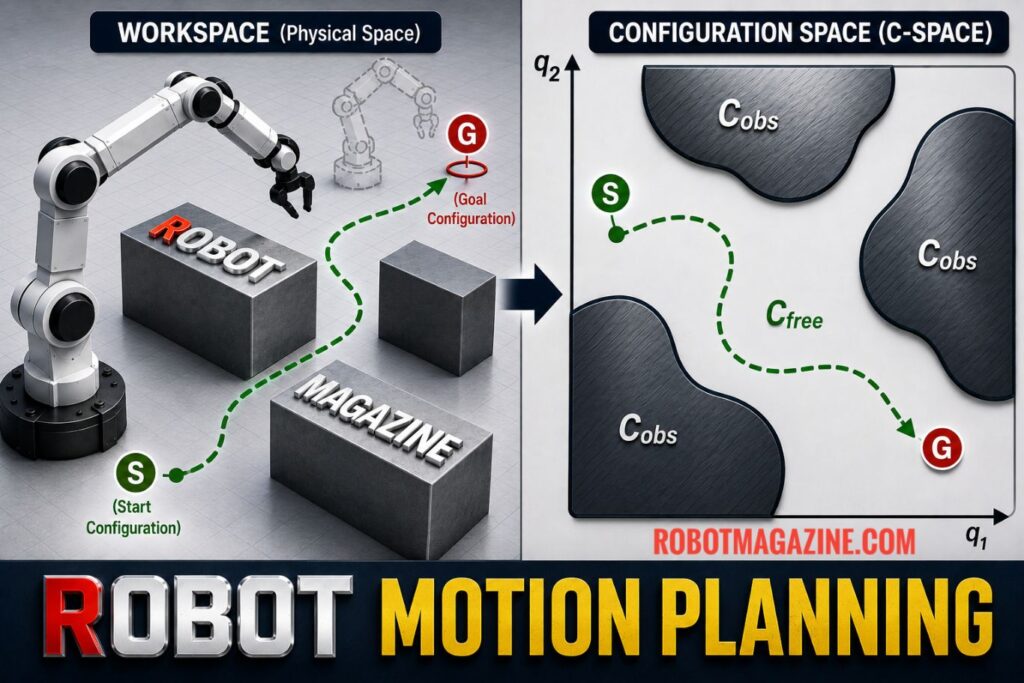
To perform this search computationally, the robot and its environment must be represented in a form a planning algorithm can use. One important representation is configuration space (C-space). Instead of planning directly around the robot’s complete geometry in its physical workspace, the robot can be represented as a point in a multidimensional space where each point corresponds to one possible robot configuration.
For a simple mobile robot, its configuration can be represented as q = (x, y, θ), where x and y define the robot’s position in the 2D environment and θ defines its orientation, or heading angle. Together, these three variables describe the robot’s position and direction.
For a humanoid robot, the configuration is much more complex than \(q=(x,y,\theta)\). It may include the position and orientation of the body, as well as the angles of the legs, arms, neck, and other joints. The exact configuration depends on the robot’s degrees of freedom and the motion being planned.
C-space can be divided into two regions. C_{free} contains configurations in which the robot does not collide with obstacles, while C_{obs} contains configurations that would result in collision. Path planning therefore becomes the problem of finding a route through C_{free} from the starting configuration to the goal.
For a given configuration \(q\), the computer uses collision detection algorithms to determine whether the robot can safely occupy that configuration. It uses the robot model to calculate the robot’s position and geometry, then checks whether any part of the robot intersects with an obstacle. If a collision would occur, the configuration belongs to \(C_{obs}\); if no collision occurs, it belongs to \(C_{free}\).
Different algorithms search this space in different ways.
Graph-based planners, such as A*, Dijkstra’s algorithm, and D*, usually represent the environment or C-space as a discrete grid or graph and search connections between states. They are widely used for mobile robots in 2D or relatively low-dimensional environments. D* is particularly useful when the map can change during navigation.
Sampling-based planners, such as Probabilistic Roadmaps (PRM) and Rapidly-exploring Random Trees (RRT), sample possible configurations, check whether they are collision-free, and use valid samples to construct a route. PRM builds a reusable roadmap, while RRT grows a tree from the starting configuration. Variants such as RRT* and PRM* can improve solution quality toward an optimal solution.
Optimization-based planners, such as CHOMP and TrajOpt, formulate motion generation as an optimization problem. They can improve factors such as smoothness, obstacle clearance, path length, energy consumption, and actuator constraints. Modern systems may combine these approaches, using a sampling-based planner to find an initial route and optimization to refine it.
Collision checking is fundamental to all approaches. Candidate configurations and proposed motions must be tested against obstacles, making collision detection one of the major computational costs of planning.
A path describes the geometric sequence of configurations from start to goal. A trajectory additionally specifies how the robot moves along that path over time, including timing, velocity, and acceleration. Thus, finding a collision-free path is only part of planning; the resulting trajectory must also be physically executable.
1.2 MANIPULATOR MOTION PLANNING
Manipulator motion planning addresses a different problem: the robot’s base remains stationary while its joints and links move through different configurations.
Consider a 6-DoF industrial robotic arm bolted to the floor. Its base does not travel through the environment, but its six joint angles can change continuously. The planner must determine how those joints should move to bring the end effector to a desired position and orientation while ensuring that no link collides with an obstacle or another part of the robot.
Here, the configuration can be represented by the joint variables:
[ q=(q_1,q_2,\ldots,q_6) ]
The C-space therefore has six dimensions. Each point represents one possible posture of the arm. As with mobile robots, C_{free} contains collision-free configurations and C_{obs} contains configurations that would cause collision.
The challenge is not simply to move the end effector from A to B. The entire robot must be considered. Two different joint configurations can place the end effector at the same position while producing completely different arm postures. One posture may be collision-free while the other causes a link to hit an obstacle.
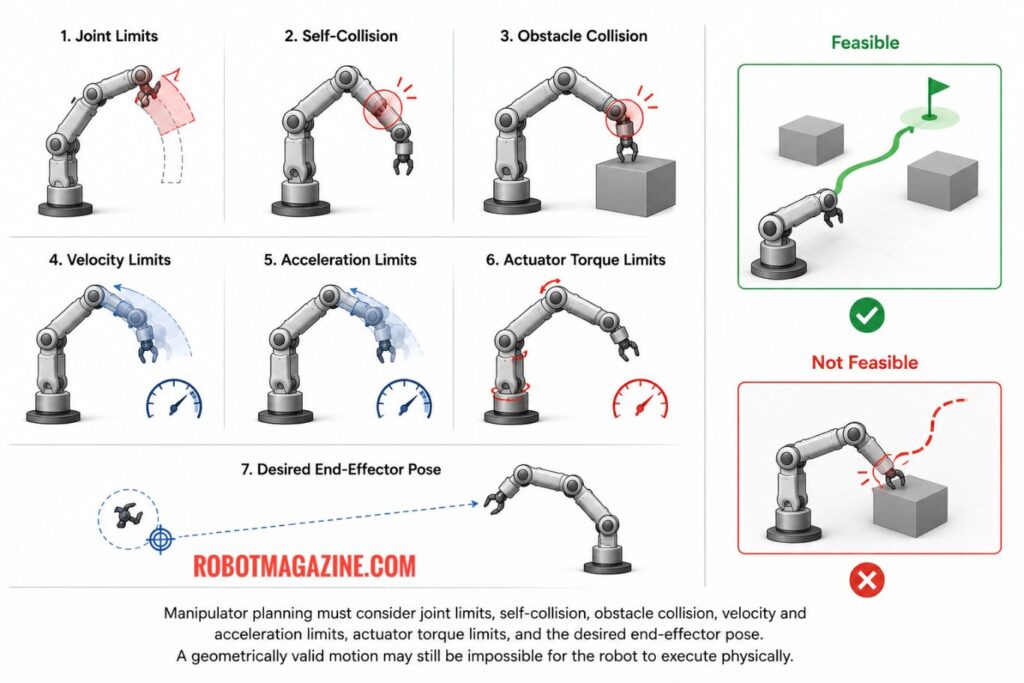
Manipulator planning must therefore consider joint limits, self-collision, obstacle collision, velocity and acceleration limits, actuator torque, and the desired end-effector pose. A geometrically valid motion may still be impossible for the robot to execute physically.
Sampling-based methods such as RRT and PRM are widely used for high-dimensional manipulators, while optimization-based methods such as CHOMP and TrajOpt can refine motions for smoothness, obstacle clearance, efficiency, and physical constraints. Model Predictive Control (MPC) can repeatedly optimize a short future horizon and adjust the motion as new information becomes available.
For manipulators, the distinction between path and trajectory is especially important. A path may specify a sequence of joint configurations,
[ q_0\rightarrow q_1\rightarrow q_2\rightarrow\cdots\rightarrow q_f ]
while the trajectory determines when each configuration is reached and therefore specifies joint velocities and accelerations. This makes the resulting motion executable by the robot’s actuators rather than merely geometrically possible.
The same planning principles can also extend to humanoid robots, although additional challenges arise from their large number of degrees of freedom, balance requirements, foot contacts, whole-body coordination, and interactions with the environment.
Ultimately, both path planning and manipulator motion planning belong to the broader field of robot motion planning. They address different physical situations, but both seek to determine feasible robot motion while respecting geometry, constraints, collision avoidance, and the requirements of the task.
Terms of Use: Unauthorized copying is prohibited; we maintain dated records to document original publication. Content may contain inaccuracies. See our Terms Page.