Industrial robots have become indispensable in modern manufacturing, delivering speed, precision, and consistency across industries ranging from automotive production and electronics assembly to food processing and logistics. Many modern robots achieve repeatability measured in hundredths of a millimeter, making them essential for applications where accuracy and consistency directly affect product quality.
However, performance alone does not determine the success of an automation system. The true value of industrial robotics depends on reliability—the ability to perform consistently over long periods with minimal interruptions. Reliable robots help manufacturers maintain stable production schedules, control operating costs, and maximize the return on their automation investments.
Why Reliability Matters
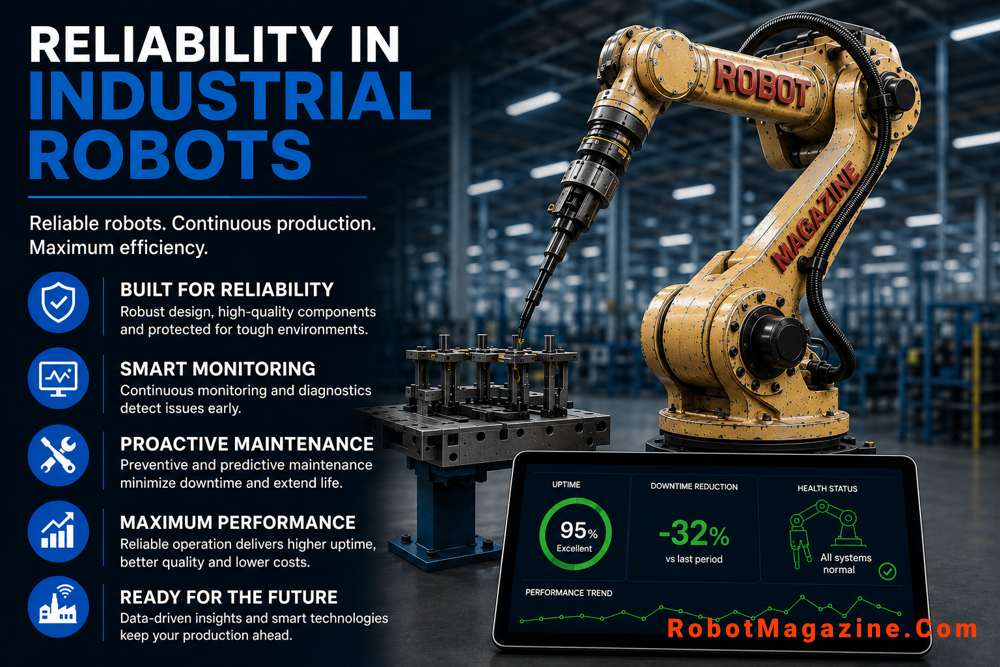
In highly automated facilities, a single robot failure can disrupt an entire production process. For this reason, manufacturers closely monitor reliability-related metrics such as:
- MTBF (Mean Time Between Failures) – The average operating time before a failure occurs.
- MTTR (Mean Time To Repair) – The average time required to restore equipment after a failure.
- OEE (Overall Equipment Effectiveness) – A measure of manufacturing productivity that combines availability, performance, and quality.
Key Benefits of High Reliability
High reliability provides several important benefits:
- Increased production uptime
- Improved product quality and consistency
- Lower maintenance costs
- Longer equipment life
- Greater operational efficiency
The growing importance of reliability reflects the rapid expansion of industrial automation worldwide. According to the International Federation of Robotics (IFR), millions of industrial robots are now operating in factories around the globe, making dependable performance a critical business requirement.
Factors That Influence Robot Reliability
Reliability is influenced by both equipment design and operating conditions.
Mechanical Design
Industrial robots perform millions of repetitive movements throughout their service life. Gears, bearings, joints, and structural components must withstand continuous mechanical stress while maintaining accuracy and performance. Robust mechanical design helps minimize wear, preserve precision, and extend operational life.
Component Quality
Servo motors, controllers, sensors, encoders, power supplies, and communication systems all contribute to overall reliability. High-quality components generally provide greater stability and lower failure rates, particularly in demanding industrial environments.
Cable Management
One frequently overlooked reliability factor is cable management. Industrial robots often carry electrical, pneumatic, and communication lines along their arms. These cable bundles, commonly called dress packs, are subjected to constant bending and twisting during operation. Over time, cable fatigue and connector wear can cause unexpected failures if not properly monitored and maintained.
Environmental Conditions
The operating environment can significantly affect robot reliability. Dust, moisture, heat, vibration, and chemical exposure all place additional stress on robotic systems. Selecting robots with appropriate protection ratings and environmental safeguards helps ensure dependable long-term operation.
The Role of Maintenance
Even the most advanced robot requires regular maintenance to maintain reliability throughout its service life.
Preventive Maintenance
Preventive maintenance relies on scheduled inspections and servicing activities designed to reduce the likelihood of failures. Typical tasks include:
- Lubricating moving components
- Checking calibration
- Inspecting cables and connectors
- Replacing wear-prone parts
- Verifying safety systems
Predictive Maintenance
Predictive maintenance uses real-time operational data to identify developing issues before they result in equipment failure. Modern robots continuously generate information about vibration, temperature, motor loads, and cycle counts. By analyzing these indicators, maintenance teams can often detect wear patterns early and schedule repairs before production is affected.
This approach is increasingly supported by major automation suppliers. For example, ABB’s predictive maintenance framework combines condition monitoring and data analytics to help manufacturers improve asset reliability and maintenance planning.
Preventive vs Predictive Maintenance
| Maintenance Strategy | Approach | Main Advantage |
| Preventive Maintenance | Scheduled servicing at fixed intervals | Simple and well established |
| Predictive Maintenance | Data-driven monitoring and analysis | Early problem detection and optimized maintenance |
Note: Many manufacturers use both approaches together to balance reliability, cost, and operational efficiency.
Reliability in the Industry 4.0 Era
Industry 4.0 technologies have transformed reliability management by enabling connected, data-driven operations. Modern robotic systems can transmit operational information to centralized monitoring platforms, allowing maintenance teams to track equipment health in real time.
Advanced Capabilities Supported:
- Real-time condition monitoring
- Remote diagnostics
- Automated alerts
- Data-driven maintenance decisions
Artificial intelligence is beginning to enhance these systems further by recognizing subtle operating patterns that may indicate developing faults.
Future Trends
Future reliability improvements will likely come from advances in artificial intelligence, digital twins, condition-monitoring sensors, and self-diagnostic systems. These technologies are expected to improve fault detection, maintenance planning, and overall equipment availability while reducing operating costs.
Conclusion
Reliability remains one of the most important characteristics of an industrial robot. Achieving dependable long-term performance requires a combination of robust engineering, quality components, effective maintenance practices, and modern monitoring technologies.
As automation continues to expand across global manufacturing, organizations that prioritize reliability will be best positioned to maximize productivity and operational efficiency.
Post By: A. Tuter
Terms of Use: Unauthorized copying is prohibited; we maintain dated records to document original publication. Content may contain inaccuracies. All trademarks mentioned belong to their respective owners; we are not affiliated with them, and no endorsement is implied. See our Terms Page.